Tuesday, December 22, 2009

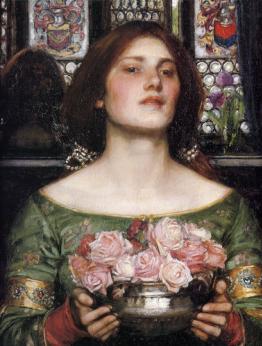
Rossetti's - Hanging the Mistletoe


Dante Gabriel Rossetti
Hanging the Mistletoe
oil on panel
32.7 x 27 cm
date on image: Xmas 1860-61
(Rossetti Archive)
Winter Beauty


yes ... it's a heart :)


Photos courtesy vtpeacenik

Celebrating the Winter Solstice


1. Photo courtesy David Brizendine - Winter Solstice 2008
2. From the video collection of hawthyn - Ring out, ring solstice bells
3. Photo courtesy JMR71 - 'Calling the Dawn'

A lovely Solstice photo from Scotland courtesy northstar37
More


2008 Winter Solstice Lantern Festival in Vancouver, BC
Photos courtesy ItzaFineDay - 2nd link

Monday, December 21, 2009

Happy Winter Solstice!


As we await the return of the light.

*******
Lovely words from Gorsedd Arberth

It is now the marker of time marks time
When light shifts in the dark
Upon itself and ebb turns back
To flow as the land lies stark


More wonderful posts shared at Gorsedd Arberth


Solstice sunset photo courtesy BarneyF

The Sacred Mistletoe

For they believe that whatever grows on these trees is sent from heaven, and is a sign that the tree has been chosen by the gods themselves. The mistletoe is very rarely to be met with; but when it is found, they gather it with solemn ceremony. This they do above all on the sixth day of the moon, from whence they date the beginnings of their months, of their years, and of their thirty years cycle, because by the sixth day the moon has plenty of vigour and has not run half its course.
After due preparations have been made for a sacrifice and a feast under the tree, they hail it as the universal healer and bring to the spot two white bulls, whose horns have never been bound before. A priest clad in a white robe climbs the tree and with a golden sickle cuts the mistletoe, which is caught in a white cloth.
... - from 'Naturalis Historia' (XVI, 95) by Pliny the Elder

When cut down at the Winter Solstice as the sun is reborn, this divine spark of the gods is drawn down to earth symbolizing the moment of conception, although the plant is prevented from actually touching the ground and its sacredness preserved by catching it in a white cloth.
The golden sickle used to cut the mistletoe represents both the sun and the moon - a union of male and female energies. The gold symbolizing the sun and the shape of the crescent blade resembling the quarter moon. ...
Pliny also tells of the sacrifice of two white bulls and, in common with the oak, the bull is sacred to Taranis. Whilst the bull (like his zodiacal counterpart Taurus) is an earth symbol, his horns reach skywards in the shape of a crescent moon, linking earth with the realm of the gods.
- Steve Tatler


1. Henri Paul Motte, Druids Cutting the Mistletoe on the Sixth Day of the Moon, circa 1890-1900 [more information from ArtMagick]
2. [information unknown]
3. E. A. Hornel and George Henry, The Druids Bringing in the Mistletoe, 1890

In the Artist's Footsteps


Image to the left is from the Kelvingrove Art Gallery and Museum

The Druids Bringing in the Mistletoe will be included in the Glasgow Boys exhibition to be shown 30 October 2010 until 23 January 2011 at the Royal Academy of Arts, London

Sunday, December 13, 2009

J. W. Waterhouse Exhibition - Garden of Enchantment


The Montreal Museum of Fine Arts
John William Waterhouse
Garden of Enchantment


The exhibition will be at The Montreal Museum of Fine Arts
through 7 February 2010.

This past summer it was at the Royal Academy of Arts, London. (look mid-way along right side of page for links)

The exhibition was first shown at the Groninger Museum, the Netherlands.

Lots of interesting information to explore
about Waterhouse and the exhibition!

****************

TV advertisement from the Montreal Museum of Fine Arts.

Review from The Art Tribune

I'll be away for a few days ... hoping you have a wonderful week!

John William Waterhouse

The Enchanted Garden

A Tale from the Decameron

johnwilliamwaterhouse.com

Lady Lever Art Gallery - The Enchanted Garden & A Tale from the Decameron

Transcript of Podcasts about A Tale from the Decameron and The Enchanted Garden from National Museums Liverpool.

Saturday, December 12, 2009

Friday, December 11, 2009

Kate Greenaway, R.I. (1846-1901)


Christmas Eve: A visit from Father Christmas
signed with initials 'K.G.' (lower right)
pencil and watercolour heightened with white
10 x 8 in. (25.4 x 20.3 cm.)

from Jane Austin's World
Wikipedia

Thursday, December 10, 2009

Helen Jackson (British, ?-1911)


1. Portrait of a lady, bust-length, wearing a red bead necklace
signed and dated 'Helen Jackson/1892' (lower right)
pencil and watercolour
20¼ x 16¼ in. (51.3 x 41.3 cm.)
2. She is Witty to Talk With (detail)
(information not available)

Harry Bright (British, 1846-1895)


1. Welcome shelter
signed and dated 1876,
watercolour and pencil heightened with bodycolour,
42.7 x 31 cm (16 3/4 x 12 1/4 in)
2. Red squirrels eating nuts on a snow covered branch before an audience of blue tits and a robin
pencil and watercolour and heightened with white
11¾ x 15½in. (29.8 x 39.5cm.)
3. A robin and greenfinches in a snowy hedgerow
watercolour and pencil heightened with bodycolour,
41.5 x 28.7 cm (16 3/8 x 11 3/8 in)

Wednesday, December 9, 2009

Frank Wilbert Stokes (1858-1955)


1. Fan-shaped Aurora Australis,
Emperor Penguin in the foreground

signed and dated 'F.W. Stokes/1915' (lower right)
oil on canvas
29¾ x 35¾in. (75.6 x 90.8cm.)
2. Midnight Sun, Inglefield Gulf, Greenland, 1893
signed and dated 'F.W. Stokes/94' (lower left)
oil on canvas
22 x 33in. (55.8 x 83.8cm.)
3. Penguins on an Ice Floe, Antarctica
oil on canvas, unframed
17¾ x 29¾in. (45.1 x 75.6cm.)

Polar Bears and Polar Bears International


A card from Matoska Trading Company

The wonderful Polar Bear and Polar Bears International -
"Conservation through Research and Education"

A Polar Bears Tale - Climate Conference in town

Katherine Cameron, R.W.S. R.E. (Scottish, 1874-1965)

The Legend of the Christmas Rose
An illustration for Amy Steedman's Legends and Stories of Italy

"And now when winter-time comes and the days are dark and the nights are long, when the snow covers up all the sleeping flowers and the Christmas bells ring out, the white blossoms of the child's flowers appear above the cold, dark earth. We call them the Christmas roses now, in memory of the little one who had no other gift to offer that first Christmas morning, but the gift of her sorrowful tears." - from Legends and Stories of Italy
New York: G. P. Putnam's Sons [1909].

Information about Katherine Cameron from Calton Gallery, Edinburgh.